Diversify the Decisions, Not Just the Assets
Overview
ADAA treats strategy selection as a source of uncertainty rather than assuming that one allocation rule can be identified as best in advance. Historical performance and risk still matter; decision diversification asks an additional question: do the strategies worth holding actually make different portfolio decisions?
The framework compares several dynamic allocation sleeves by what they choose, when they change, and how strongly they move toward defensive exposure. The goal is to identify genuine differences in decision behavior and to evaluate whether combining those differences can reduce dependence on a single rule.
Research Question
Key Findings
Selected Evidence
Selected summary statistics from the historical simulation reported in Public Working Paper v1.34. SSRN 7251518.
Three paper-aligned figures summarize the central evidence. Click any figure to inspect the full-resolution public research image.
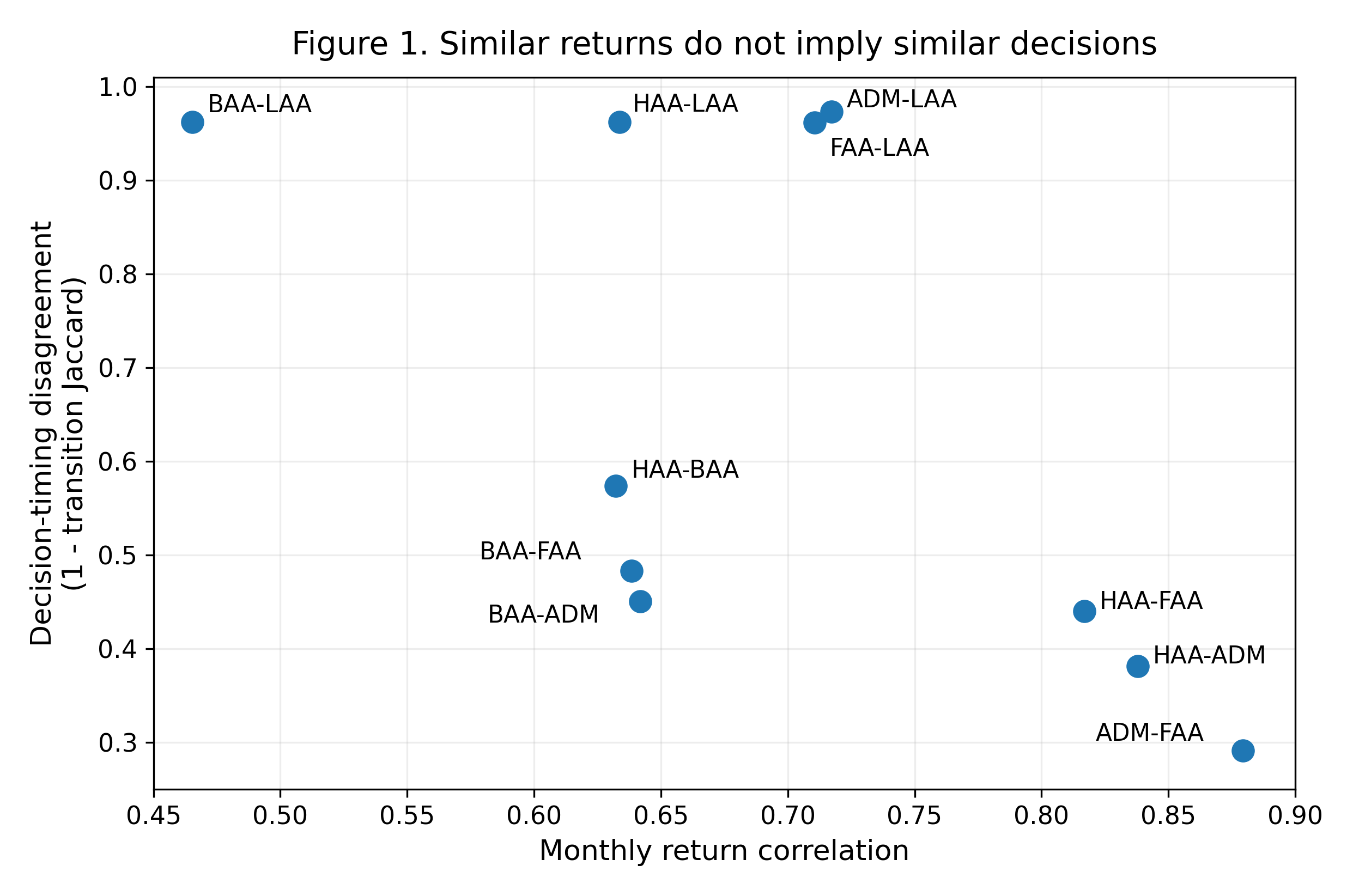
Return Correlation vs. Decision Timing
Return correlation does not fully describe decision diversification. The current sleeves can produce correlated return paths while still changing exposures at materially different times.
Open full-size figure ↗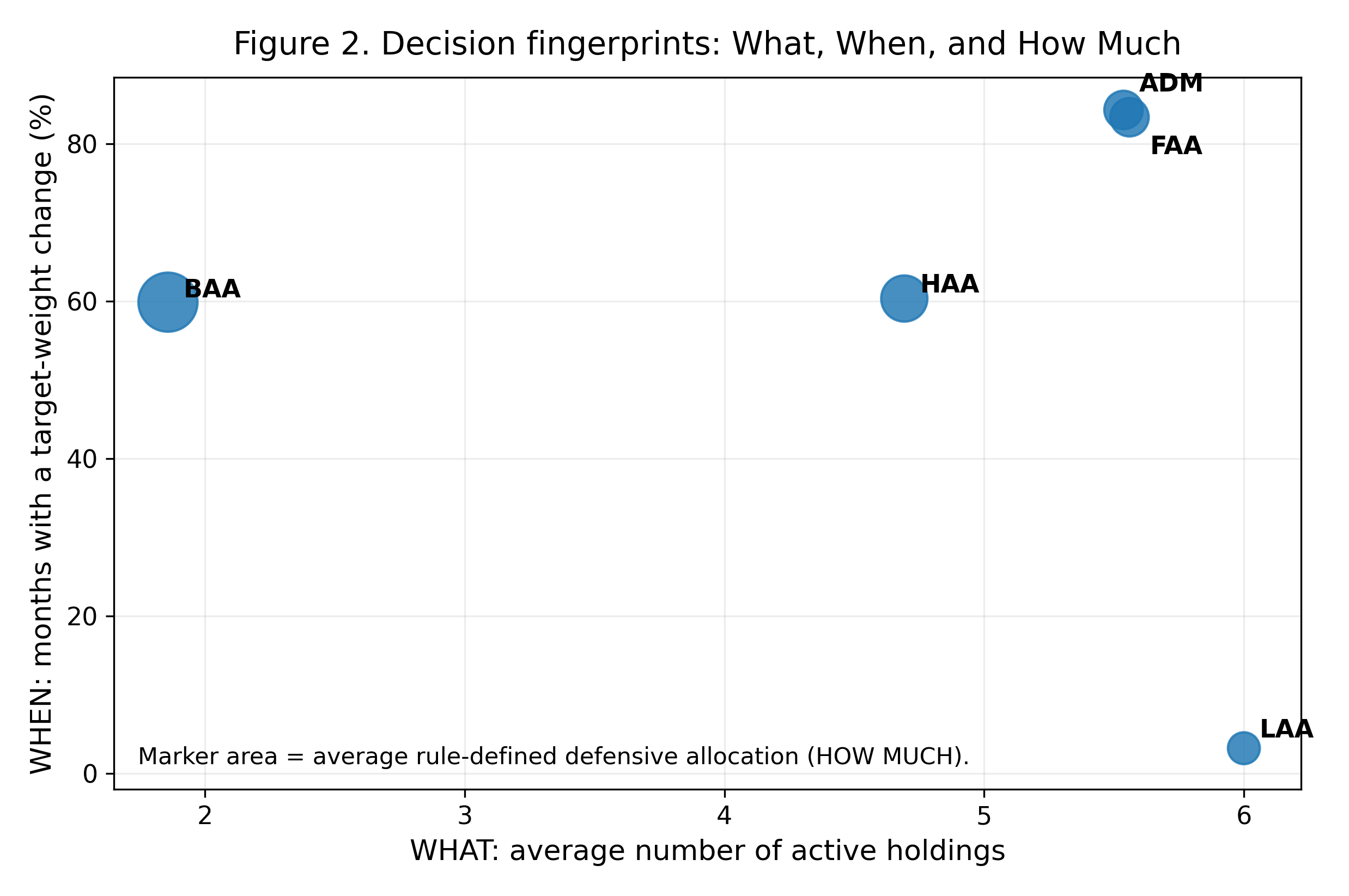
Decision Fingerprints: What, When, and How Much
The five sleeves are compared across three distinct dimensions: what they hold, when they change, and how strongly they alter risk exposure.
Open full-size figure ↗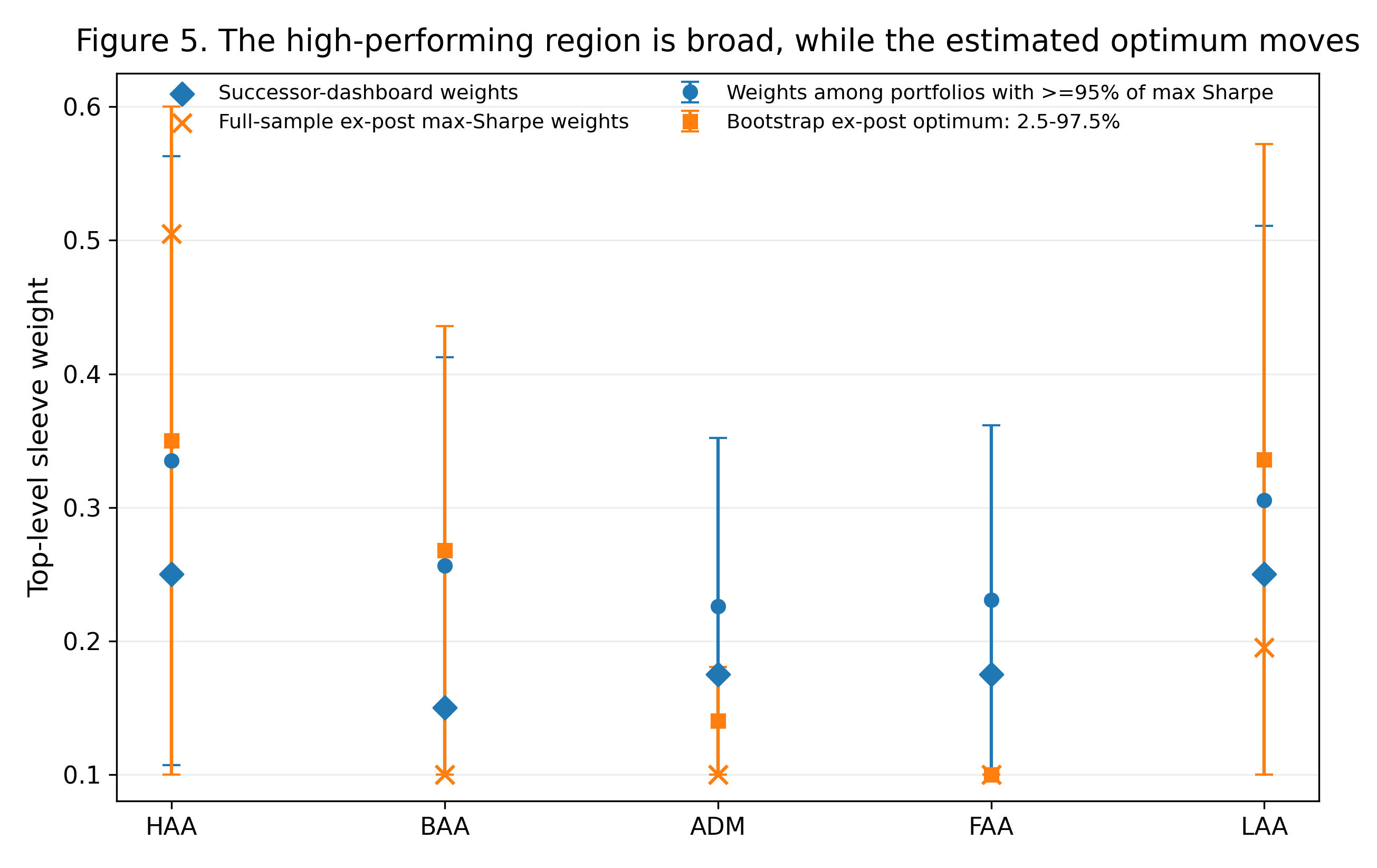
Broad Plateau, Unstable Optimum
The robustness exercise emphasizes a broad high-performing region rather than a single ex-post peak. The lesson is not to abandon optimization, but to avoid treating one historical optimum as more precise than the sample supports.
Open full-size figure ↗Methodology
Portfolio decisions
Compare which exposures the rules choose and how far their target weights differ.
Decision clocks
Measure whether different rules actually change their targets at the same times.
Risk response
Track the amount of defensive exposure and the scale of allocation changes.
Methods used in this research
These companion articles explain methods used directly in the study or needed to interpret its design and evidence.
Portfolio Backtesting and Rebalancing
Explains the portfolio accounting, weight drift, monthly rebalancing, turnover conventions, and next-period timing needed to interpret the portfolio paths used in this research.
Momentum and Trend Signals
Explains how momentum and trend signals are defined, timed, and stress-tested across lookback choices before they are translated into portfolio decisions.
Strategy Similarity and Decision Diversification
Explains how return similarity differs from similarity in what strategies hold, when they change, and how strongly they change risk exposure.
Reproducibility
Public code and reproducibility materials are maintained in the project repository. Additional replication or archival links appear here when they are part of the public research release.
Replication Package
Latest tagged public package: v1.1.4. The repository is synchronized to the current v1.34 paper.
Open release ↗Research and Implementation
This page is the Investment Research record aligned with the cited paper. The separate ADAA System page covers current operation and links back to this versioned research evidence.
ADAA Research Dashboard
Paper-aligned, versioned research evidence, selected figures, and links to the corresponding public research materials.
Open Research DashboardADAA Dashboard
Current public implementation and portfolio-monitoring views. Source data are refreshed and the canonical 19-ETF snapshot is validated before deployment; public sessions consume the validated bundled snapshot and remain separate from the versioned research record.
Open Dashboard